

Overview
Find
AI-assisted analysis across your operational data.


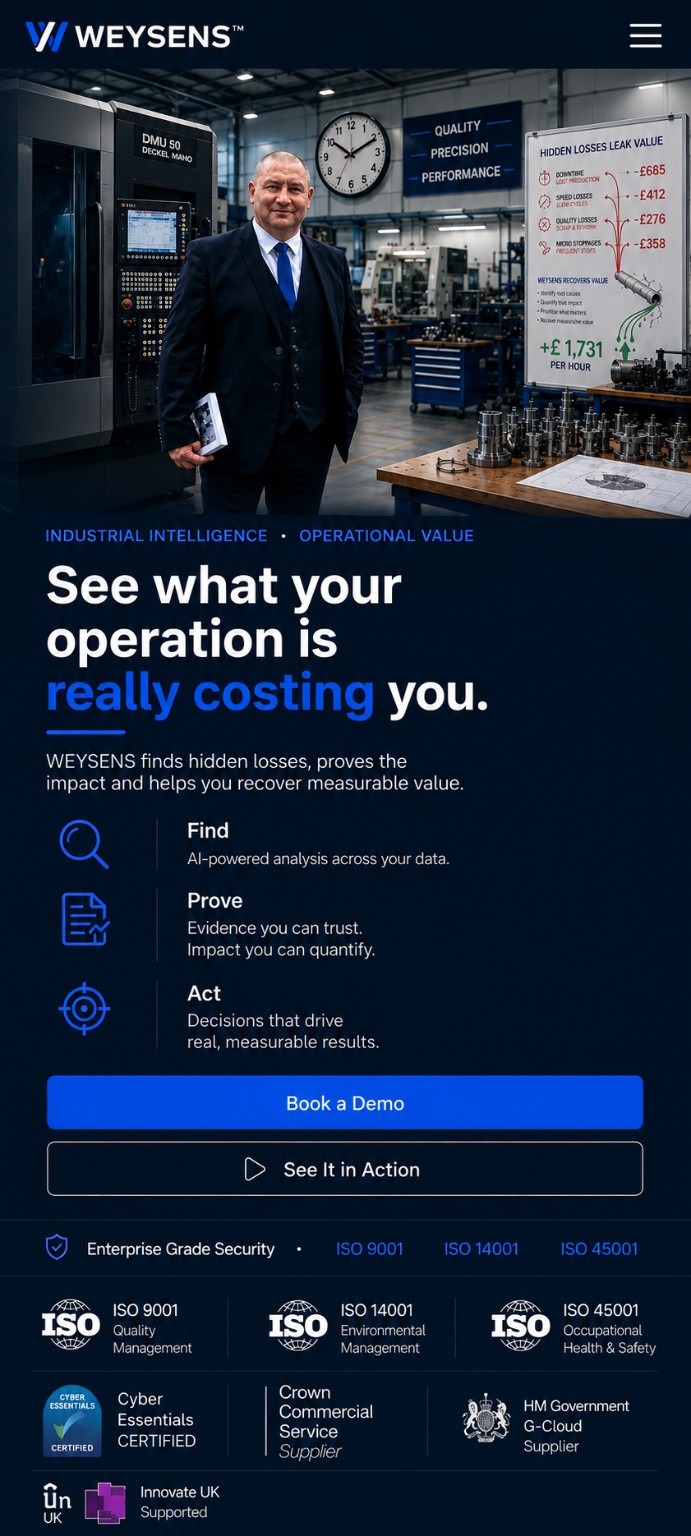
WEYSENS finds hidden losses, proves the impact and helps you recover measurable value.
AI-assisted analysis across your operational data.
Evidence you can trust. Impact you can quantify.
Decisions that drive real, measurable results.
WEYSENS finds hidden losses, proves the impact and helps you recover measurable value.
AI-assisted analysis across your operational data.
Evidence you can trust. Impact you can quantify.
Decisions that drive real, measurable results.
Most systems tell you what happened. WEYSENS is designed to show which recurring losses deserve attention first — and why.
Production signals, events, context and operating conditions.
Patterns, recurrence, contributing factors and plausible causes.
Translate operational loss into cost, risk and recoverable value.
Prioritise intervention and verify whether value was actually recovered.
Source signals, assumptions, confidence and financial logic stay inspectable, so engineering and commercial teams can challenge the same value case.
Cycle time variance +18.4% across repeated production runs.
Micro-stoppage frequency rises as cycle instability increases.
Estimated recoverable value £724/hour at current production mix.
Inspect spindle control and upstream feed stability before capacity investment.
Downtime, OEE loss, cycle variation, scrap and bottlenecks.
Explore manufacturing →Throughput, yield, energy intensity, stability and chronic deviation.
Explore process operations →Recurring failures, intervention value and reliability priorities.
Explore maintenance →Defects, rework, process drift and evidence of the cost of poor quality.
Explore quality →Walk through an illustrative investigation: detect a recurring loss, inspect the evidence, challenge the value assumptions and move towards an engineering action.
Use a few operating assumptions to estimate the possible commercial scale of a recurring loss before deeper analysis.
A WEYSENS pilot starts with one bounded operational problem, an agreed value model and a before/after evidence trail. Scale only when the evidence supports it.
Traceability, controlled assumptions, least privilege, auditability and human review are design requirements. Formal certifications appear only when genuinely held.
Read our security & trust approach →Findings remain linked to source evidence and assumptions.
The system supports expert judgement rather than hiding it.
Financial impact is explainable and challengeable.
Security controls are treated as product requirements, not decoration.
We begin with one bounded operational problem, the evidence already available and the assumptions needed to test whether a pilot is justified.